Get started
Loading documentation… Datool DocsDatool Docs
How project data, recorded behavior, and evaluations fit together.
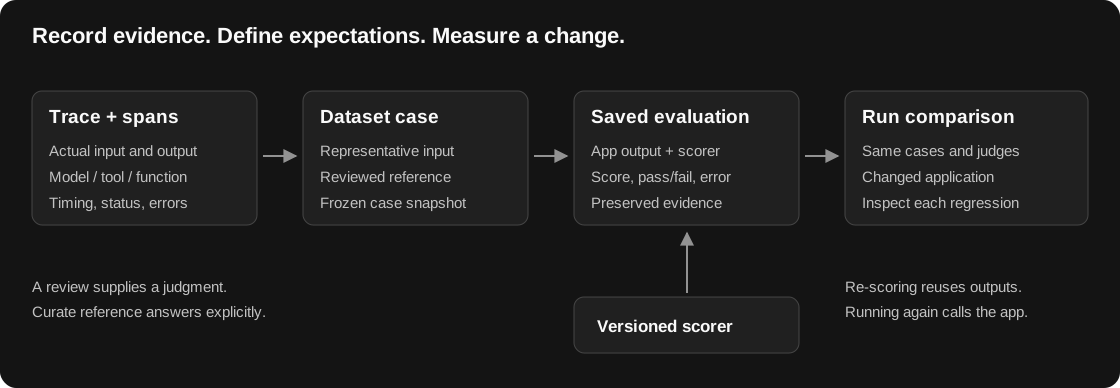
An organization owns projects and controls membership. A project contains traces, datasets, scorers, prompts, dashboards, and evaluation runs. Choose the project before investigating or changing data. A project slug identifies its browser route; API requests use the project ID.
A trace records an execution with its input, output, timing, and status. Spans describe operations inside that execution, such as a model call, tool call, or function. Parent relationships preserve the execution tree.
An operation's kind describes what happened. Its optional group associates it with a named agent or workflow. Group membership is explicit and does not change its kind or automatically apply to its children.
A session connects related traces, such as multiple turns of a conversation. Agents and Workflows collect operations with an explicit group name and optional version. Their operation counts are not necessarily counts of complete end-to-end workflow executions.
A dataset holds cases with inputs, expected outputs, and metadata. A scorer evaluates trace evidence, optionally against a dataset case. It can use code or a language model.
A numeric score and a pass decision are separate values. Execution errors and missing evidence must be read alongside the score; they are not automatically equivalent to a score of zero.
An evaluation run applies scorers to cases and recorded evidence. Connected runs invoke an app for each case. Re-scoring evaluates saved evidence again. Saved snapshots and scorer versions help explain what produced a result even after a dataset or scorer changes.
Send your first trace, then follow the evaluation guide.