Tracing
Loading documentation… Datool DocsDatool Docs
Record a complete AI SDK 7 model call with Datool's OpenTelemetry processor.
This Node.js recipe records your normal generateText call. It uses AI SDK 7's telemetry registration and the legacy AI SDK span adapter supported by Datool. No manual workflow or span wrapper is needed.
Use Node.js 22.18 or later:
npm init -y
npm install @datool/sdk@0.3.1 ai@7 @ai-sdk/otel @opentelemetry/api@1 @opentelemetry/sdk-trace-node@2
Create .env with DATOOL_BASE_URL, DATOOL_PROJECT_ID, and DATOOL_API_KEY as in your first trace. The key needs traces:write. Add AI_GATEWAY_API_KEY for Vercel AI Gateway. The model call incurs provider usage; the Datool key is not a model-provider key.
Save ai-sdk.mjs:
import { NodeTracerProvider } from "@opentelemetry/sdk-trace-node"
import { generateText, registerTelemetry } from "ai"
import { LegacyOpenTelemetry } from "@ai-sdk/otel"
import { DatoolSpanProcessor } from "@datool/sdk/otel"

const processor = new DatoolSpanProcessor()
const provider = new NodeTracerProvider({ spanProcessors: [processor] })
provider.register()
registerTelemetry(new LegacyOpenTelemetry())

try {
  const result = await generateText({
    model: "openai/gpt-4.1-mini",
    prompt: "Explain AI observability in one sentence.",
    telemetry: { functionId: "docs-greeting" },
  })
  console.log(result.text)
} finally {
  try {
    await processor.forceFlush()
  } finally {
    await provider.shutdown()
  }
}
node --env-file=.env ai-sdk.mjsOpen Traces in the configured project and find the latest docs-greeting call. Expect a completed trace with nested model spans, captured prompt and response, and token usage when reported by the provider. The functionId supplies an application name for dashboard attribution. A model error should appear on the recorded execution; a Datool delivery error is surfaced by the flush.
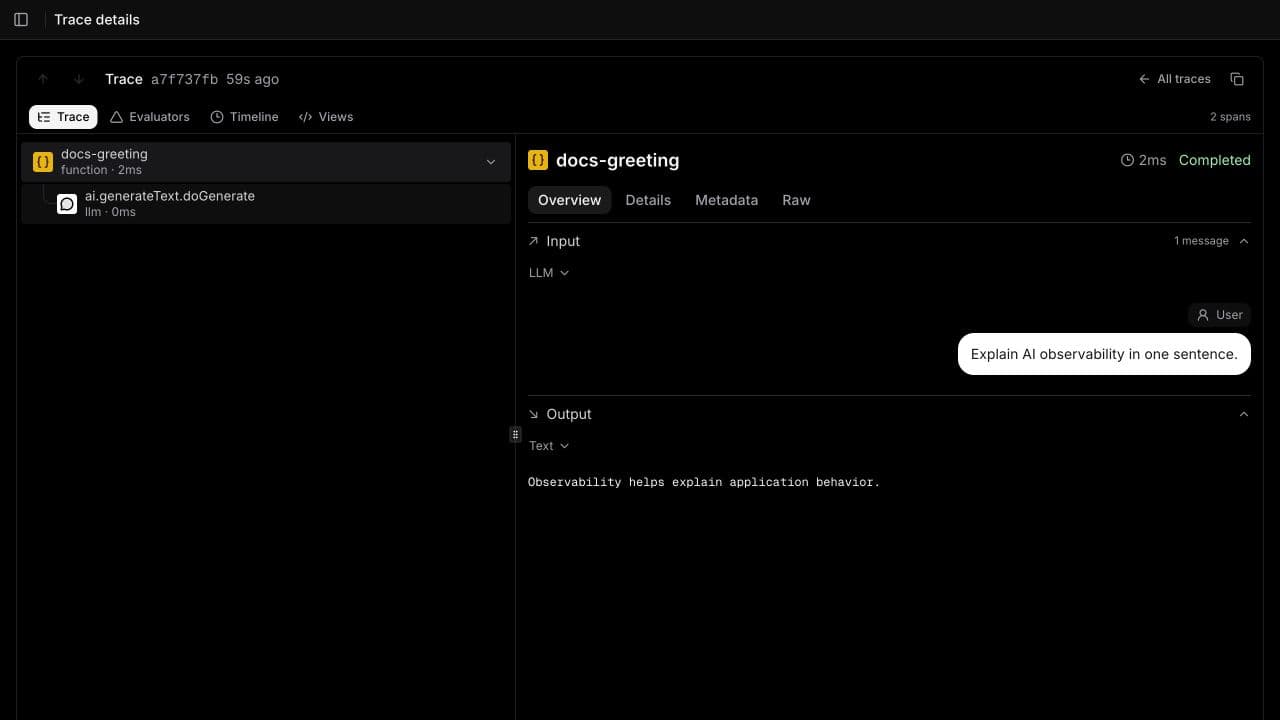
The inspector above uses a synthetic model response inside an additional application workflow. The recipe here starts directly at the AI SDK call. Select the nested LLM span to inspect its model and token usage; the parent function shows the application-level prompt and result. Live responses and timings vary.
Register the Datool processor on your existing OpenTelemetry provider once. Avoid creating a second global provider. AI SDK calls inherit the active OpenTelemetry context, so calls made inside an existing span become its children. See manual instrumentation when you need to trace application work outside model calls.
AI SDK 6 enables telemetry through experimental_telemetry: { isEnabled: true } on each call; it does not use this AI SDK 7 registration recipe. Follow the AI SDK telemetry documentation for your installed major version and retain your lockfile.
For streamText, consume the stream fully before flushing or shutting down the provider. A server that returns a streaming response must keep telemetry work alive until the stream ends. In a serverless request, use the platform's supported post-response lifetime hook.
To omit sensitive model content, use telemetry: { recordInputs: false, recordOutputs: false } on the call. These settings do not redact independently recorded application payloads. The processor's transform hook can apply your redaction policy before delivery.
If model spans are missing, check the adapter registration and provider initialization order. If nothing appears, check project selection, key scope, and the ingestion worker before changing model settings. See troubleshooting.